
Captures what's wasted or harmful
High-energy UV (280–400 nm) ages plastic films and stresses plant tissue; green light (500–550 nm) is simply used inefficiently by photosynthesis. isigrow pigments absorb both.
isigrow
isigrow puts luminescent, inorganic pigments into films and photovoltaic panels. They turn the parts of sunlight plants use poorly into the parts they use best — no active lighting, powered by sunlight only.
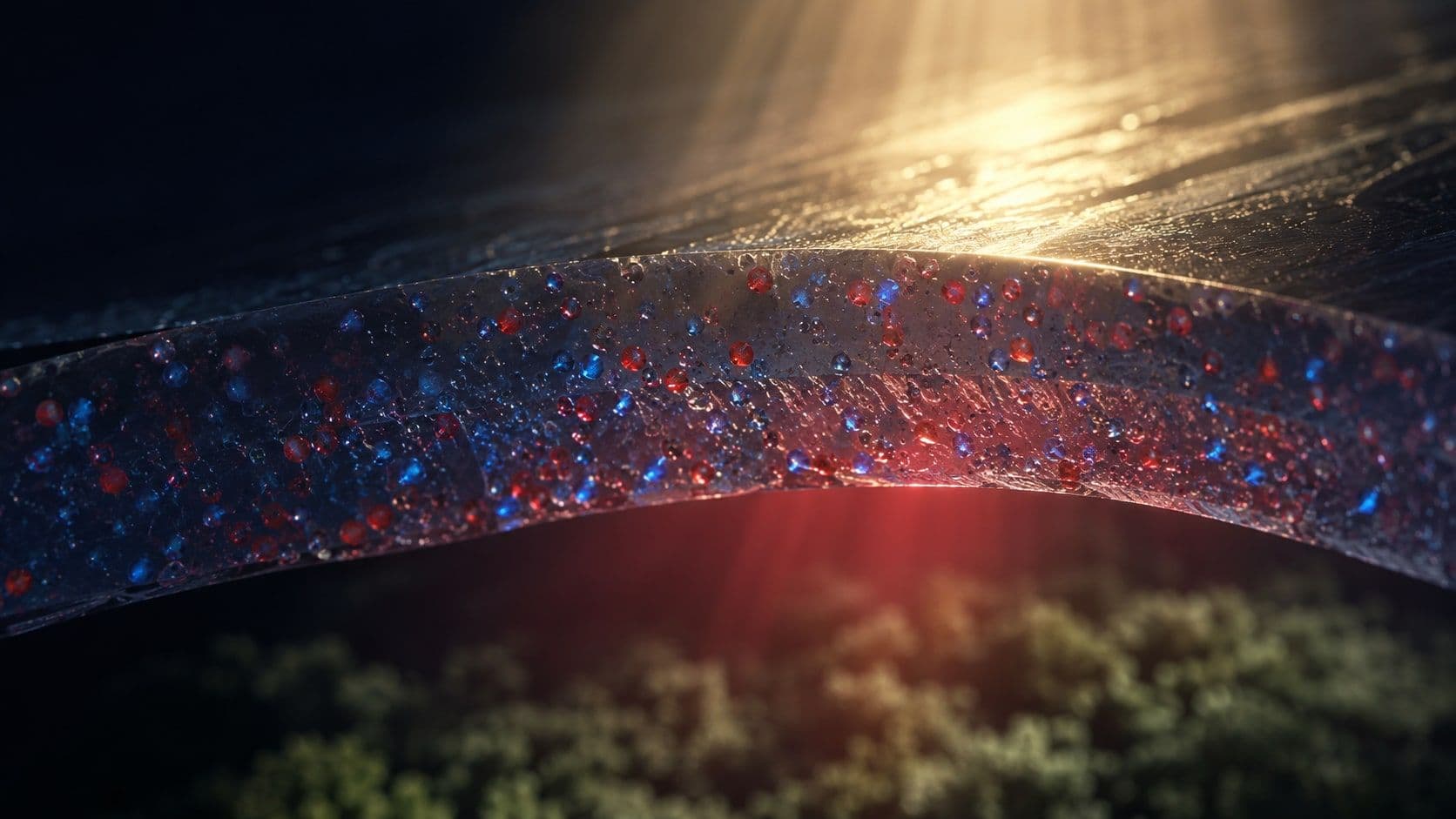
High-energy UV (280–400 nm) ages plastic films and stresses plant tissue; green light (500–550 nm) is simply used inefficiently by photosynthesis. isigrow pigments absorb both.
Inorganic luminescent pigments re-emit that energy as blue (450–490 nm) and deep red (660–680 nm) — the wavelengths photosynthesis uses best.
Shifting light toward the wavelengths photosynthesis uses best creates the basis for stronger growth — while the same UV absorption helps protect the film or module itself.
Spectrum shift
Plants don't use all of sunlight equally. isigrow pigments move energy from where it's wasted — or harmful — to where it drives growth.
Grow crops and generate power on the same land. isigrow brings light conversion to the transparent areas of PV modules — so a single installation feeds both the plants below and the grid. In an agri-PV field, solar cells cover only part of the panel. isigrow places converting pigments in the transparent zones between the cells: UV that would degrade the module is absorbed, and the light reaching the crop is shifted toward the wavelengths plants use best. Module protection and plant benefit are two separate effects of the same layer — one surface, power and crop together.
isigrow effect: sunlight is shifted toward the wavelengths plants use best. The efficiency this creates is being evaluated in prototype modules — project data available on request, under NDA.
isigrow effect: UV absorption reduces exposure to a known stress factor for the module's solar cells beneath the film.
Agri-PV effect (Fraunhofer ISE): renewable power for the farm plus a crop, from the same footprint — panel shade also cuts irrigation demand by up to 20%. These are benefits of agri-PV itself; isigrow adds the light conversion on top. Where no power is needed, the film runs PV-free to save cost.
The same conversion, in the film itself. isigrow turns a greenhouse cover from a passive UV shield into an active layer — converting light instead of just blocking it.
Conventional films rely on organic UV stabilizers that wear out. isigrow absorbs and converts UV instead of merely blocking it — turning a passive shield into an active layer.
By absorbing UV, isigrow extends film life. How much depends on the region and its solar load — the effect is real everywhere, the years are not a fixed number.
More usable light for photosynthesis can support yield — how much depends on crop and region, assessed case by case rather than promised as a fixed number.
Stable inorganic pigments, free of rare earths — no reaction with the plastic matrix.
Integrates into established film and panel manufacturing — no new process required.
No active lighting, no added energy input. The conversion runs on the sun.
isigrow is a development field, not a catalog product. Films and photovoltaic modules with isigrow pigments are running as prototypes today. If you want to see project data or discuss a pilot for your application, we can share specifics under NDA.